Triage · Movement AI

Mobility as a new and missing health vital.

Mobility as a new and missing health vital.

Objective, AMA and OSHA-aligned range of motion assessment in under two minutes. Audio-guided, asymmetry detection on every joint on any camera-enabled device.

Multi-region

Multi-region

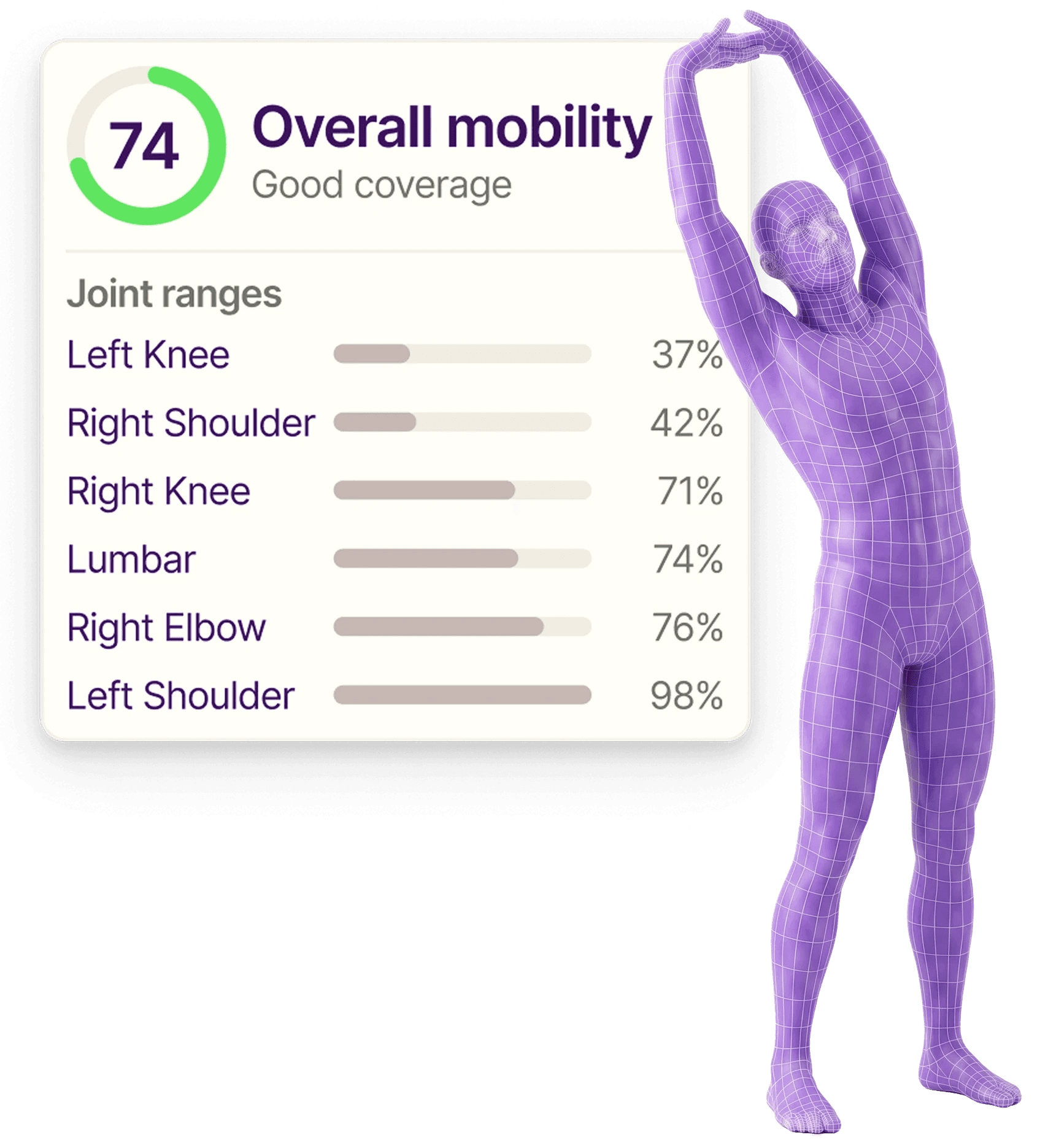
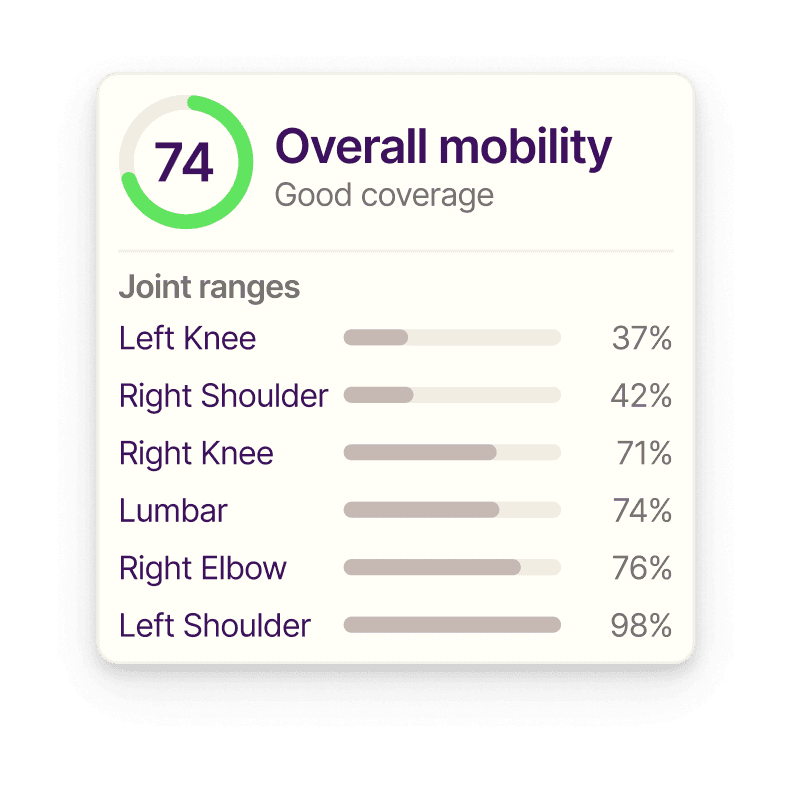
Our AI-powered ROM scan measures joint-by-joint range of motion, flags left-right asymmetries, and delivers a traffic-light coded report — so clinicians and users know exactly where to focus and what to do next.

Lifestyle or condition specific

measurement

Joint-by-joint

measurement

Left vs right asymmetry

Detection on every joint

Audio-guided

Scan — no clinician needed in the room

Under 2 min

For a full assessment

AMA · OSHA · HIPAA

Aligned end-to-end
THE PLATFORM

From scan to corrective program, in one system.

From scan to corrective program, in one system.

CareSpace's platform runs the full continuum — Triage, Prehab, Rehab. This is where objective movement data enters the system. A two-minute, audio-guided scan establishes baseline range of motion across every major joint, flags asymmetries the eye can't reliably see, and produces a calibrated, AMA-aligned report.

CareSpace's platform runs the full continuum — Triage, Prehab, Rehab. This is where objective movement data enters the system. A two-minute, audio-guided scan establishes baseline range of motion across every major joint, flags asymmetries the eye can't reliably see, and produces a calibrated, AMA-aligned report.

CareSpace's platform runs the full continuum — Triage, Prehab, Rehab. This is where objective movement data enters the system. A two-minute, audio-guided scan establishes baseline range of motion across every major joint, flags asymmetries the eye can't reliably see, and produces a calibrated, AMA-aligned report.

What the scan produces feeds directly into Prehab: AI-matched corrective programs designed for the specific limitations and asymmetries the scan picked up. No handoff, no second visit, no separate tool.

What the scan produces feeds directly into Prehab: AI-matched corrective programs designed for the specific limitations and asymmetries the scan picked up. No handoff, no second visit, no separate tool.

HOW IT WORKS

Audio-guided. Multi-region. Repeatable.

Audio-guided. Multi-region. Repeatable.

1

Setup.

First-time scan, returning-user check-in, or routine player — the experience adapts to where the user is in their journey.

1

Setup.

First-time scan, returning-user check-in, or routine player — the experience adapts to where the user is in their journey.

2

Stand or sit.

Standing baseline for full-body screening; sitting baseline for limited-mobility users, recovery scenarios, or seated-work populations.

2

Stand or sit.

Standing baseline for full-body screening; sitting baseline for limited-mobility users, recovery scenarios, or seated-work populations.

3

Follow along with Janelle.

Janelle, your AI movement coach, walks you through every movement on-screen — shoulder, neck, elbow / wrist, lumbar, lower body, squat, arm abduction, and more. No clinician in the room required.

3

Follow along with Janelle.

Janelle, your AI movement coach, walks you through every movement on-screen — shoulder, neck, elbow / wrist, lumbar, lower body, squat, arm abduction, and more. No clinician in the room required.

4

Capture and measure.

Any camera-enabled device tracks the alignment points that define each joint's range, scoring the motion against AMA-recognized thresholds.

4

Capture and measure.

Any camera-enabled device tracks the alignment points that define each joint's range, scoring the motion against AMA-recognized thresholds.

5

Read the report.

Joint-by-joint range scores, traffic-light coded for clarity, with asymmetry badges flagging left-right imbalance — and a corrective program assigned automatically.

5

Read the report.

Joint-by-joint range scores, traffic-light coded for clarity, with asymmetry badges flagging left-right imbalance — and a corrective program assigned automatically.

6

Re-scan to track.

Every 4–6 weeks. Deltas show change over time; programs adapt to it.

6

Re-scan to track.

Every 4–6 weeks. Deltas show change over time; programs adapt to it.

1

Setup.

First-time scan, returning-user check-in, or routine player — the experience adapts to where the user is in their journey.

3

Follow along with Janelle.

Janelle, your AI movement coach, walks you through every movement on-screen — shoulder, neck, elbow / wrist, lumbar, lower body, squat, arm abduction, and more. No clinician in the room required.

5

Read the report.

Joint-by-joint range scores, traffic-light coded for clarity, with asymmetry badges flagging left-right imbalance — and a corrective program assigned automatically.

2

Stand or sit.

Standing baseline for full-body screening; sitting baseline for limited-mobility users, recovery scenarios, or seated-work populations.

4

Capture and measure.

Any camera-enabled device tracks the alignment points that define each joint's range, scoring the motion against AMA-recognized thresholds.

6

Re-scan to track.

Every 4–6 weeks. Deltas show change over time; programs adapt to it.

Helping organizations implement a movement culture.

Helping organizations implement a movement culture.

Musculoskeletal injuries cause 56% of all workplace injuries and cost U.S. employers nearly $32.6 billion a year, most of it preventable with earlier, objective screening.

  • Healthcare & Rehabilitation

    Standardize ROM measurement across PT, OT, and hospital settings — defensible, repeatable, documentation-ready.

  • Insurance

    Objective MSK baselines for risk stratification, claims, and value-based reimbursement.

  • Employers & Occupational Health

    Screening, return-to-work clearance, and MSD monitoring, addressing a cost category worth billions to U.S. employers.

  • Senior & Long-Term Care

    Detect mobility decline early; sitting-baseline mode keeps the scan inclusive.

  • Sports & Performance

    Catch asymmetries before they become overuse injuries; baseline athletes pre-season.

  • Construction & Manufacturing

    OSHA-aligned ROM screening for high-risk physical roles.

  • Public Services

    Maintain readiness in first responders and frontline workers with repeatable checks.

  • Correctional Facilities

    Secure, in-place ROM screening at population scale.

  • Population Health

    Population-level mobility analytics for prevention and policy.

CLINICAL VALIDATION & COMPLIANCE

Built on OSHA safety standards

Clinically validated.

CareSpace's 12-Week Clinical Assessment Study: 95% of users reported pain improvement, 100% reported better function, 100% showed measurable mobility gains, with an 8.4/10 overall satisfaction score.

OSHA and AMA aligned.

ROM thresholds calibrated to OSHA 29 CFR 1910 guidelines and AMA-recognized standards — supporting MSD screening, ergonomic risk reporting, and occupational compliance.

Supervised where it matters.

Licensed physical therapists oversee the clinical workflows that need them.

HIPAA-compliant end-to-end

All scans, ROM reports, and clinical records are encrypted and stored in a private, enterprise-grade environment, with client-branded HIPAA environments available.

Clinically validated.

CareSpace's 12-Week Clinical Assessment Study: 95% of users reported pain improvement, 100% reported better function, 100% showed measurable mobility gains, with an 8.4/10 overall satisfaction score.

Supervised where it matters.

Licensed physical therapists oversee the clinical workflows that need them.

OSHA and AMA aligned.

ROM thresholds calibrated to OSHA 29 CFR 1910 guidelines and AMA-recognized standards — supporting MSD screening, ergonomic risk reporting, and occupational compliance.

HIPAA-compliant end-to-end

All scans, ROM reports, and clinical records are encrypted and stored in a private, enterprise-grade environment, with client-branded HIPAA environments available.

Clinically validated.

CareSpace's 12-Week Clinical Assessment Study: 95% of users reported pain improvement, 100% reported better function, 100% showed measurable mobility gains, with an 8.4/10 overall satisfaction score.

Supervised where it matters.

Licensed physical therapists oversee the clinical workflows that need them.

OSHA and AMA aligned.

ROM thresholds calibrated to OSHA 29 CFR 1910 guidelines and AMA-recognized standards — supporting MSD screening, ergonomic risk reporting, and occupational compliance.

HIPAA-compliant end-to-end

All scans, ROM reports, and clinical records are encrypted and stored in a private, enterprise-grade environment, with client-branded HIPAA environments available.

WHAT THE SCAN DELIVERS

Turn movement data into custom care plans.

Turn movement data into
custom care plans.

Turn movement data into custom care plans.

Carespace is where Triage gets objective. In under two minutes, on any device, CareSpace turns a guided ROM scan into clinical-grade insight and a care plan ready to deploy — at the scale your organization needs.

Joint-by-joint scoring

Across every major region of the body, with side-to-side asymmetry flagged automatically.

Confidence calibration

on every finding: what's precise, what's estimated, what needs a closer look in person

Baseline + delta tracking

every scan compared to the user's own history.

Printable, clinician-ready PDF report

for clinical, occupational, or insurance documentation.

Traffic-light coded findings

Clear, cautious, limited — scored against AMA-recognized clinical standards, not internal benchmarks.

Auto-assigned exercise program

Personalized exercises and programs, matched to your joint scores and asymmetries — not a generic template.

CUSTOM SCANS

One scan doesn't fit every body.
Build the one that fits yours.

One scan doesn't fit every body.
Build the one that fits yours.

CareSpace includes an authoring tool that lets you build custom scans around the specific demands of a job, a role, a lifestyle, or a condition so you're measuring what actually matters to that person.

Post-stroke recovery

Track shoulder, hip & ankle ROM week over week.

Pickleball injury prevention

Screen shoulder, hip & knee mobility before overuse injuries happen.

CareSpace ecosystem

Each piece feeds the next. Body composition, posture, mobility, and movement come together into a single profile that updates every time you check in.

Frequently Asked Questions

Frequently Asked Questions

Do users need special equipment?

No. Any phone, tablet, or webcam works. No wearables, no goniometers, no clinic visit.

How long does a scan take?

Under two minutes for a full multi-region scan. Report and program are ready immediately.

What body regions does the scan cover?

Shoulder, neck, elbow / wrist, lumbar, lower body, squat, arm abduction, and more — covering every major joint involved in everyday movement and work tasks.

Can users with limited mobility use it?

Yes. The sitting baseline mode is designed for users who can't reliably perform a standing scan — post-surgical patients, seated-work populations, older adults, and recovery scenarios.

Is the scan a clinical diagnosis?

No. It's an objective screening and baseline tool. Where a finding warrants clinical follow-up, the report says so explicitly.

How accurate is the scoring?

Calibrated to AMA and OSHA-recognized ROM standards. Each finding ships with a confidence indicator so users and clinicians know what's measured precisely versus estimated.

Can the scan be supervised by a clinician remotely?

Yes. The audio-guided protocol makes self-administered scans reliable, and clinician dashboards allow oversight, review, and report annotation at scale.

How is patient data protected?

HIPAA-compliant, end-to-end encrypted, stored in compliant cloud infrastructure. Client-branded HIPAA environments are available for enterprise deployments.